What Faith-Based Preschool Curriculum Covers and Why It Matters
Quick Answer
Faith-based preschool curriculum brings together early childhood learning and spiritual formation in a way that feels natural and whole. Children explore literacy, math, science, and social-emotional skills alongside values like kindness, community, and care, all within a program shaped by the beliefs your family holds dear. It is an approach that sees the whole child: their mind, their heart, and their growing sense of who they are in the world. If you are exploring faith-based preschools, this guide will walk you through what to look for and what a strong program really delivers.
A school that feels like an extension of your family
If you have been searching for a preschool that feels like a genuine extension of your family’s values, a community that shares what you believe and how you want to raise your kids, you already know what you are looking for. You want a school where your child’s faith is woven into daily life, where the teachers know your family, and where kindness and character are treated as seriously as any academic skill. Faith-aligned curriculum is built on exactly that. If you have been searching for faith-based programs in Olive Branch, MS, Memphis, TN, or nearby communities, here is what you can expect from a strong one.
What faith-aligned curriculum is built around
At its core, faith-based preschool curriculum is early childhood education, the full range of it. Children build language, early math and literacy, fine and gross motor skills, social-emotional competency, and the kind of curiosity that will carry them through a lifetime of learning. What makes it distinctive is the framework it lives inside.
Faith-based programs integrate values, spiritual formation, and community into the daily life of the classroom. According to Childcare.gov, faith-based programs give families the opportunity to place their children in environments that reflect their religious beliefs while still providing age-appropriate learning, socialization, and development. Prayer, celebration, and community traditions are part of the rhythm of the day. They are not add-ons. They are core.
What the curriculum covers day to day
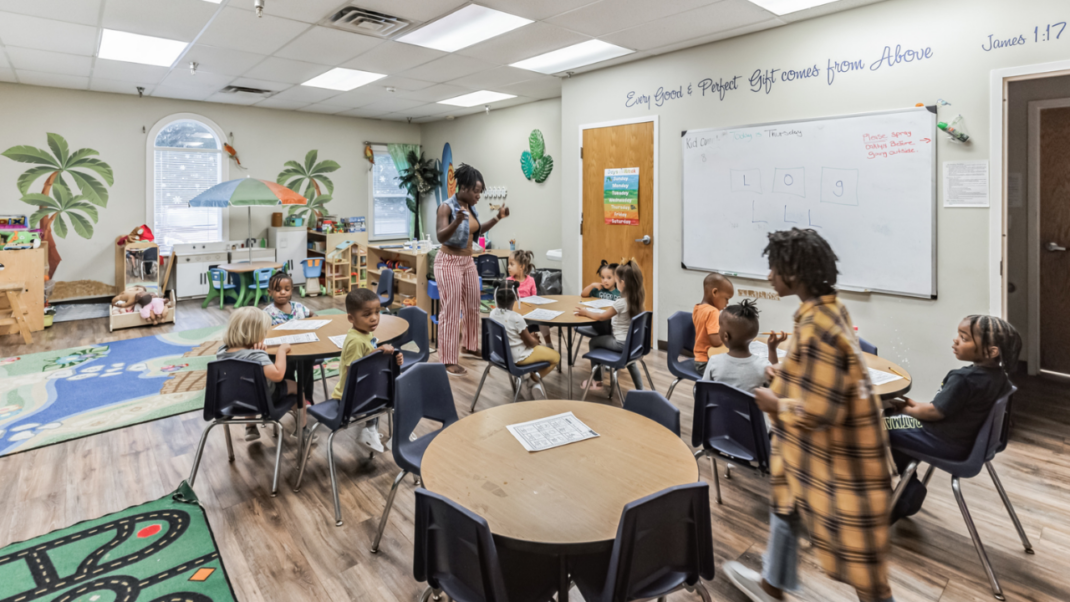
Imagine your child’s morning at a faith-based preschool. They might begin with a gathering time that includes a song, a prayer, and a story. Then they move into learning centers: literacy activities, math games, art, dramatic play. Throughout the day, the values woven into the curriculum show up in small and meaningful ways. How children are encouraged to treat one another. How conflict is navigated. What stories are told and why.
Faith-based early childhood curriculum pairs Bible stories and faith concepts with developmentally appropriate activities for preschool and pre-K children, using a spiral learning model so that key ideas revisit and deepen over time. And it involves families, which is a clear signal that faith-based education at its best is a partnership between school and home.
The community piece
Here is something families often say after their first year in a faith-based program: ‘We did not just find a school. We found our people.’ That is the community dimension of faith-based education, and it is real. These programs tend to bring together families with shared values, and that creates a warmth and continuity that extends well beyond the classroom walls.
Events, celebrations, and family gatherings are often built into the program year. Children learn early that faith is communal, something practiced together. That experience of belonging is a powerful part of what the curriculum delivers, and it is something you really do feel when you walk into a school like this.
Frequently Asked Questions About Faith-Aligned Curriculum
How does faith-aligned curriculum build a sense of belonging in young children?
Young children develop their earliest understanding of community inside the classroom. In a faith-based program, that community is shaped by something deeper than proximity. Children learn that kindness, service, and care for others are not just social skills but values with meaning behind them. Celebrations, shared prayers, and community traditions give children a sense of rhythm and belonging that extends beyond their classroom and into the larger community your family is part of. That experience of being known, valued, and connected is not incidental to the curriculum. For many families, it is the reason they chose a faith-based program in the first place.
Will my child get the same academic preparation in a faith-based program?
Yes. Strong faith-based preschool programs meet and often exceed early childhood development standards. Children build early literacy, math, science, and social-emotional skills just as they would in any high-quality program. The difference is the setting. These skills develop within a community shaped by shared values, care, and faith.
How do faith-based preschools partner with families?
Family partnership is a core part of quality faith-based programs. Many share resources to help continue faith conversations at home, involve families in celebrations and community events, and communicate regularly about children’s growth. The strongest programs see themselves as partners with families, supporting your role rather than stepping in for it.
Schedule a tour
Families in Olive Branch, MS, Memphis, TN, and nearby communities choose Cornerstone Learning Center because our program supports each child’s growth, sense of belonging, and connection to shared values. We’d love to show you what that looks like in person. Schedule a tour today.
Related Posts
All Posts
Free Pre-K vs. Private Childcare: What Families in Memphis, TN Are Actually Weighing
Inside Christian Preschool Classrooms: Where Faith and Learning Grow Together